

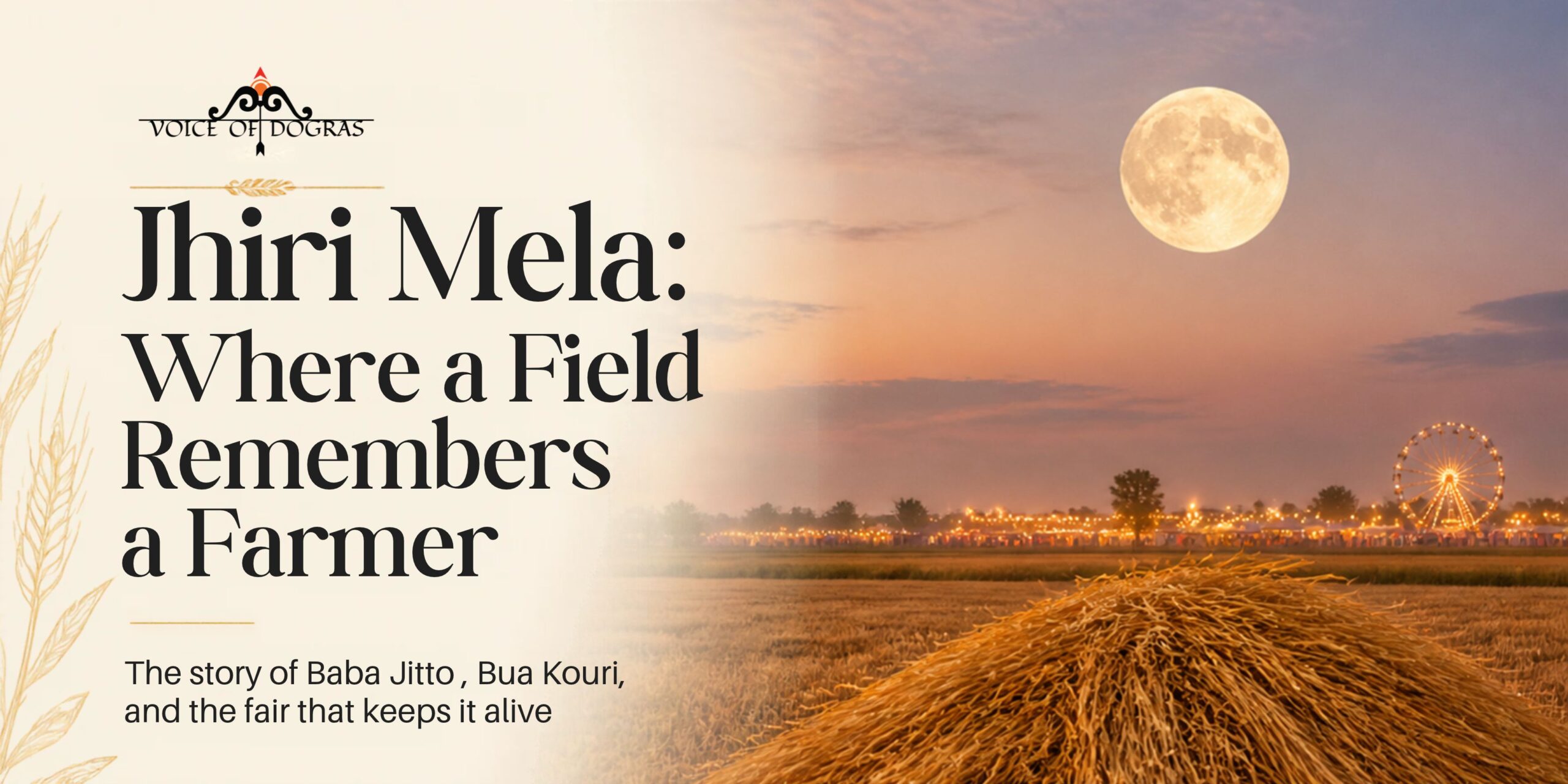
A heap of wheat, golden in the late sun.
A man sitting on top of it.
And a choice that a whole region has refused to forget for five hundred years.
Every November, when the autumn full moon rises over the plains west of Jammu, the village of Jhiri fills up for the Jhiri Mela. Not with tourists, mostly. With families. Farmers from Jammu, Punjab, Himachal Pradesh and Haryana arrive with bundles, children on shoulders, and a story they’ve carried down through generations.
The mela is that story, retold with footsteps.
Who was Baba Jitto?
His name was Jit Mal. People came to call him Jitto, and later, with affection, Baba Jitto.
He was a farmer from Aghar, a village near Katra in today’s Reasi district. Accounts say trouble at home, a quarrel over family land, pushed him out. He left with his young daughter, Kouri.
Father and daughter walked to Panjod, a village in the Marh area of Jammu, where Jitto’s friend Rullo, a blacksmith, took them in. Jitto didn’t want to be a burden for long. He asked for one thing. A piece of land to work.
He found it with Mehta Bir Singh, the local landlord of the Amb Ghrota area. The land he was given was barren. The deal, as the tradition tells it, was that Jitto would hand over one quarter of whatever he grew and keep the rest.
So he worked. He cleared it. He coaxed it. And one season the barren field gave back a heavy, shining crop of wheat.
That’s when the deal changed.
When word of the harvest reached Bir Singh, he came to the field with his men and told them to lift three quarters of the crop and leave Jitto only one.
A heap of grain, and a line he would not cross
What do you do when the people with power simply rewrite the terms?
Jitto refused to hand over the grain. Then, as the story is told, he sat down on the heap and took his own life with a dagger, so that the grain was soaked in his blood. Grain no one could ever eat with a clear conscience.
Not surrender. Refusal.
Folk tradition adds that his daughter, Bua Kouri, gave her life at her father’s funeral pyre. The two are remembered together today, in twin shrines at Jhiri.
It’s worth saying gently that this is folk history. Sources don’t agree on the exact century. Some place it in the 15th, others in the 16th. The details shift a little from telling to telling.
The heart of it doesn’t.
The songs that carried him
For a long time, this story didn’t live in books.
It lived in voices.
Dogri folk ballads carried it from village to village. Storytellers knew exactly where to slow down: the barren field turning green, the landlord’s men arriving, the heap of grain. Listeners who had heard it a hundred times still went quiet at the same places.
Then writing caught up. In 1881, Pandit Nilkanth, a court poet of Maharaja Ranbir Singh, set the story down in Katha Baba Jitto Di. In his telling, the king of Jammu at the time, Ajab Dev, was only a small child, so his maternal uncles ran the state and appointed chieftains like Bir Singh to govern the land.
Others followed. Pandit Shukdev Shastri wrote Jitto-Charitra. Prof. Ramnath Shastri wrote about Jitto among the folk heroes of the Duggar region, and wrote a play called Bawa Jitto. In 1986, the Jammu theatre group Natrang staged it, directed by Balwant Thakur.
Natrang has kept coming back. For the last 25 years, it has staged Bawa Jitto at the Jhiri Mela itself, on the main stage, under the same autumn sky where the story is remembered.
The tellings don’t always agree. Nilkanth calls Rullo a friend. Shukdev Shastri calls him a servant.
Not one fixed story. A river with many streams, all flowing toward the same place.
Why do people still come?
Here’s the part that stays with me.
Local belief holds that the families whose ancestors ate even a little of that grain still come to Jhiri, generation after generation, to repent for it.
Think about that. A wrong done five centuries ago, and people still travel to say sorry for it.
Not a festival of victory. A festival of conscience.
Over time, Baba Jitto became something larger than one man. For the farmers of the region, he is a protector, and a reminder that the person who grows the food deserves a fair share of it. That’s why Jhiri Mela is also called the Farmers’ Fair.
Eight days under an autumn moon
The mela begins around Kartik Purnima, the full moon of late autumn, and runs for roughly eight to ten days, usually in late October or November. This year, the mela runs from 23 November to 3 December, with Kartik Purnima on 24 November as the main day.
Most visitors begin at the twin temples of Baba Jitto and Bua Kouri. Many then walk on to nearby Shama Chak, where devotees have built hundreds of small memorials.
A dip in Baba da Talab, a pond about four kilometres from the temple, is a custom for many. People believe its water heals, especially troubles of the skin.
Community langar runs all through the mela. And around the quiet of the shrines, the fair does what fairs do: sweet stalls, giant wheels, merry-go-rounds, and the happy noise of children who don’t know the whole story yet, but will.
The fair has a practical side now too. The Jammu Department of Agriculture Production and Farmers Welfare helps prepare it, and officials have pushed for kiosks that tell farmers about government schemes. A fair born from one farmer’s refusal now helps other farmers find their footing.
Crowd estimates swing widely from year to year, from around five lakh to well over ten lakh visitors. For 2026, organisers expect close to 15 lakh. Whatever the true number, it is one of the largest gatherings in North India.
Where the story began: Aghar Jitto
Jhiri is where Baba Jitto’s story ended.
Aghar is where it began.
His birthplace, now called Aghar Jitto, sits about five to six kilometres from Katra on the Katra Reasi road. Every June it holds its own three-day mela, organised by the district administration together with the Baba Jitto Mandir Development Committee.
The first night belongs to music. A jatra at his birthplace carries on until morning, with bhajans sung in his memory. On the second day, a Sobha Yatra procession sets out from the same place.
People in Aghar remember that the village once had so little water that everyone, Jitto included, walked a long way to fetch it. They say seven streams later came up there. And after every harvest, many farmers in the area still offer their first grain to Baba Jitto before their own families eat it.
Not two separate fairs. One life, remembered at both ends.
How to reach Jhiri
Jhiri lies in the Marh area of Jammu district, about 20 km west of Jammu city, off the Jammu Akhnoor road.
- By air: Jammu airport is the nearest, about 27 km away.
- By train: Jammu railway station is about 24 km away. From there, take a taxi or a local bus.
- By bus: Mini buses run from Jammu city to Kana Chak, the village right next to Jhiri. During the mela, the Jammu district administration arranges extra transport.
- By car: Drive out of Jammu on the Akhnoor road and follow the signs for Jhiri and Kana Chak. Expect slow traffic and busy parking around the main day.
If you’re planning to go
- Check the dates every year. The mela follows the lunar calendar, so it moves. Watch for announcements from the Jammu district administration or J&K Tourism.
- Go early in the day. Kartik Purnima itself draws the biggest crowds.
- Wear comfortable shoes. There’s plenty of walking between the temples, Shama Chak and the pond.
- Travel light. Keep valuables close in the crowds.
- Ask a local to tell you the story. It sounds different from someone whose grandmother told it to them.
What a field remembers
Most monuments are made of stone.
This one is made of people. Of return. Of families who keep showing up because someone, long ago, told them they should.
Maybe this is what justice looks like when there was none at the time. Not a verdict. A memory that refuses to fade.
That evening, when the full moon climbs over Jhiri, the stalls light up one by one. And somewhere in the crowd, a grandfather is telling a child about a man who sat on a heap of wheat and would not move.
Frequently asked questions
When is Jhiri Mela held?
Every year around Kartik Purnima, the autumn full moon, usually in late October or November. It lasts about eight to ten days. In 2026 it runs from 23 November to 3 December, with the main day on 24 November.
Where is Jhiri?
Jhiri is a village in the Marh area of Jammu district, Jammu and Kashmir, about 20 km west of Jammu city, off the Jammu Akhnoor road.
Who was Baba Jitto?
Baba Jitto, born Jit Mal, was a farmer from Aghar village near Katra. According to tradition, he gave his life rather than surrender his harvest to a landlord who broke their agreement. He is remembered as a protector of farmers and a Dogra folk hero.
Who was Bua Kouri?
Bua Kouri was Baba Jitto’s daughter. Tradition says she gave her life at her father’s funeral pyre. Devotees honour both of them at the twin temples in Jhiri.
Why is Jhiri Mela called the Farmers’ Fair?
Because it honours a farmer who stood up for a fair share of what he grew. Farmers from across North India come to pay their respects, and the fair now also shares information on farming schemes.
What is Baba da Talab?
Baba da Talab is a pond about four kilometres from the Baba Jitto temple. Many visitors take a dip there during the mela, believing its water heals, especially skin troubles.
Is there another mela for Baba Jitto?
Yes. A three-day mela is held every June at Aghar Jitto, his birthplace near Katra in Reasi district.

Comments are closed, but trackbacks and pingbacks are open.