

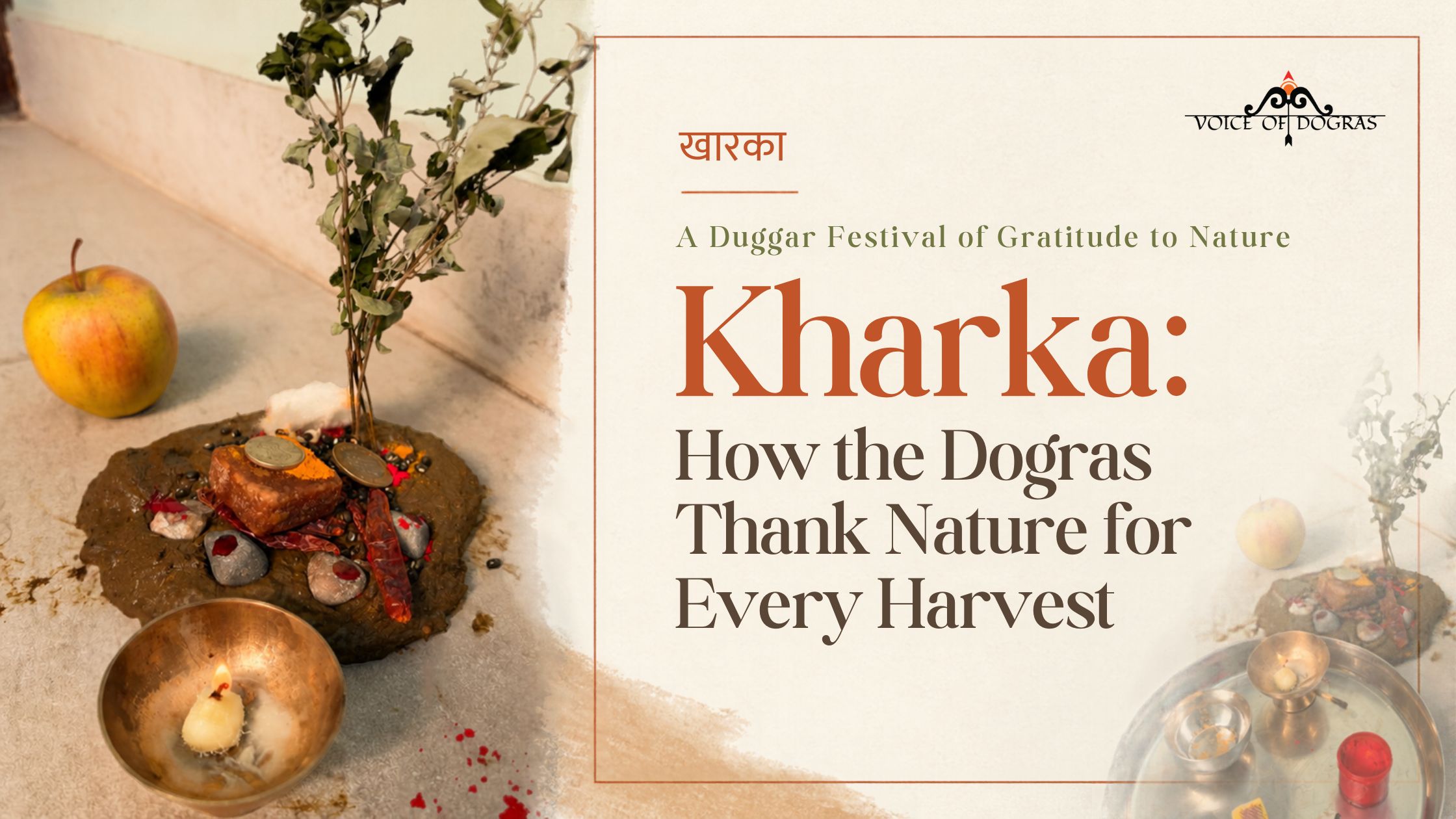
नवी फ़सल आने पर खारका दिन्देन। देवते दे नां दीयां जातरा दिंदेन। एदेच खिचड़ी, बबरु, ते और पकवान बंदेन। सारे कोला पेहले काँ गी ते कुते गी बल बाई जंदी ऐ। इसदे बाद जोड़ें गी रुटी खलॉंदेंन। खारका सालेच दो बार आंदा, अपरैल ते अकतूबर।
As our elders tell it, in Dogri.
The first grain of the season is still warm from the fire.
The khichdi is ready. The babbru are golden. A child reaches for one.
And a hand gently stops her.
Not yet.
Someone else eats first.
Twice a year, the grain waits
In the hills and villages of Duggar, there is a small festival with a large heart. It is called Kharka.
It comes twice a year, whenever a new crop reaches home. In April, when the kanak (wheat) is cut. In October, when the maah (black urad) is gathered in.
The new grain is not eaten straight away. It waits.
First, a jatra is offered in the name of the devta. Then the cooking begins: khichdi, babbru and other dishes, all made from the fresh harvest. Then, before any person takes a bite, a share is set out for the crows and the dogs. Then the joda is fed, the newly wed pair. And only after all of this does the household taste what its own fields have grown.
In Dogri, the rule fits in one breath: सारें कोला पैहलें कां ते कुत्ते गी बल। Before everyone else, the crow’s and the dog’s share.
And Kharka is not kept only at one’s own door. Like Jaatar and Pattar Puja, Dogra families also offer it at the home of the maternal uncle. The thanks of the harvest travel along the threads of family, from one courtyard to another.
It sounds simple. Almost too simple to call a festival.
But sit with the order of it for a moment. God. Creature. Guest. Self.
The family that worked hardest for this grain eats last.
How we celebrate Kharka
The pooja is small enough to fit in one corner of the house. And yet everything the land gave is gathered there.
This is how it looked in our home this year.
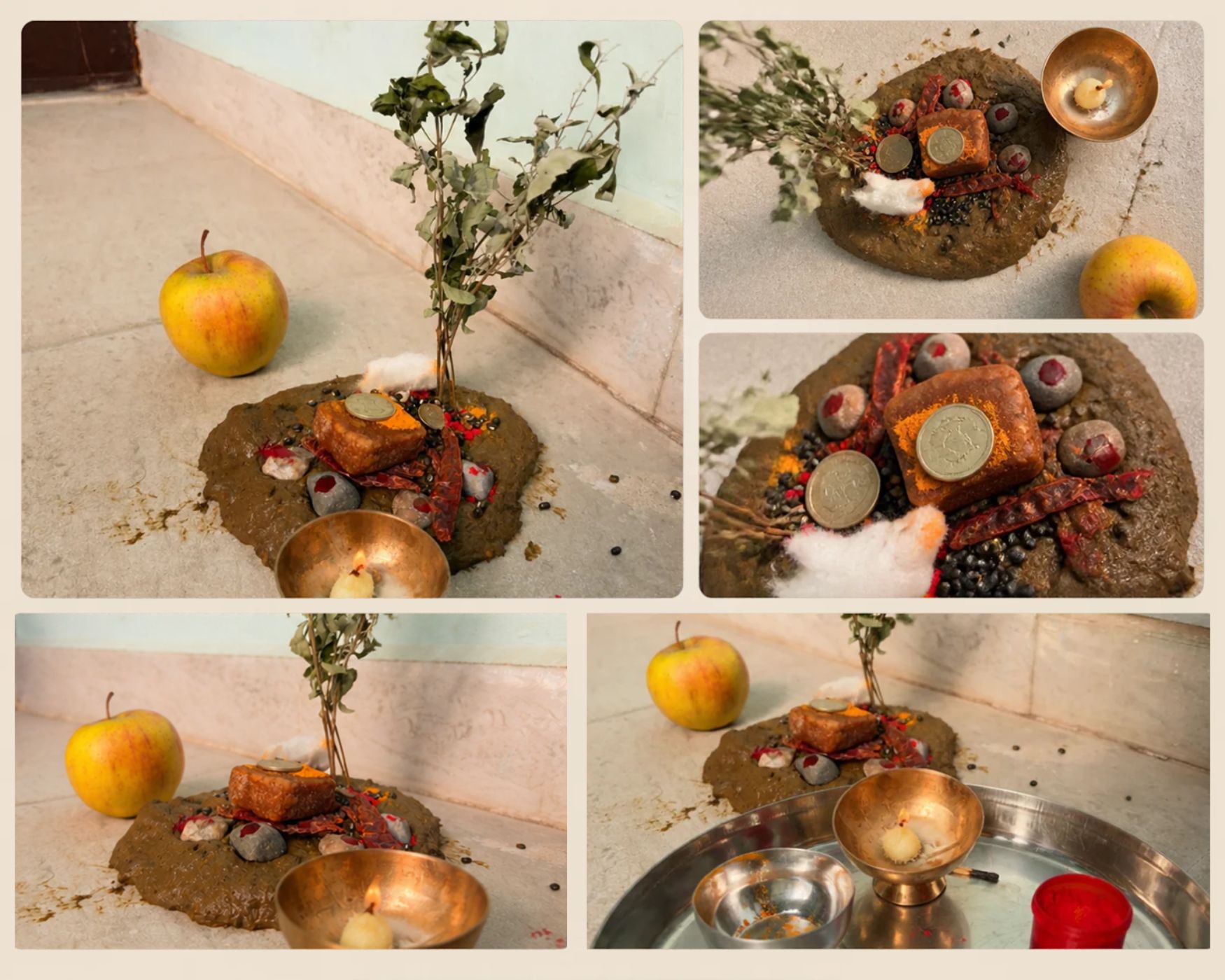
It begins by choosing the place.
Kharka is always offered beside a water source. In the villages, that means a spring, a stream or a baoli. In our cities, where no river runs past the door, we set it beside the tap that brings fresh water into the home.
The reason is as old as farming itself. No grain grows without water. So the thanks for the harvest is given where water flows, close to the source of everything that was grown.
Then the ground is readied.
A corner of the floor is swept clean and spread with fresh gobar. In a Dogra home, this is how earth is made pure enough to receive. Nothing is built on top of the floor. The floor itself becomes the altar.
Seven small stones are set into the gobar, each touched with sindoor. In our home, they are for Bua Daati. Beside them rise a few branches of banaa, pressed upright into the earth, as if a small forest has come indoors to bear witness.
Then the harvest arrives at her feet.
Grains of fresh maah, the black urad just brought in from the fields. A lump of gur, the portion of same gur that will sweeten the babbru. A few dried red chillies, set aside from what will go into the khichdi.
Look closely and you see it. Nothing on this altar was bought for worship. It holds the very meal the family is about to cook. Bua Daati tastes the Kharka feast before anyone else in the house.
Around the grain sit the small signs of a blessed home. Haldi, the colour of all that is shubh. Sindoor, the red every suhagin carries. A few coins and a fruit. And a soft tuft of white cotton, standing in for the cloth we offer, the way one gifts new clothes to an honoured elder of the family.
Last, a diya is lit. Its small flame keeps watch.
Then comes the prayer to Bua Daati, and the jatra in the name of the devta. Then the cooking, the crow’s share, the dog’s share and the joda’s meal. Just as our elders did.
Look again at that small patch of gobar, and the fresh water flowing beside it. Water. Earth. Stone. Tree. Grain. Sweetness. Fire. Almost all of it came from the land, and all of it is offered back.
Not a grand altar. A small piece of the earth, held in the hands of a family.
Who eats first?
Why a crow? Why a dog?
They are not rare. They do not hide in far forests. They live right here, on our rooftops and at our gates.
And look closely. There is beauty in both. The crow’s black wing turning blue in the morning light. Its sharp mind, which remembers a kind face for years. The dog’s steady loyalty, awake at the door before anyone else in the house.
Kharka chooses them for that closeness.
The crow cleans what the village throws away. The dog keeps watch over the fields at night and walks beside the farmer at dawn. These are the creatures who live closest to us, who share our edges and our scraps. Kharka notices them. It says: you were part of this harvest too.
And for the crow there is one more reason, perhaps the deepest one.
In Dogra homes, the crow is the messenger of the pitr, our ancestors. Food given to the crow is believed to reach those who once walked and ploughed these very fields.
At Kharka, the same faith is at work. The first grain of the new harvest goes back to the ones who cleared these terraces, planted the first seeds and taught us when to sow and when to reap.
The harvest was theirs before it was ours.
This is the wisdom of our Dogra ancestors. They lived it in every village of Duggar, harvest after harvest, and handed it down to us without ever writing it in a book. The grandmother setting aside the crow’s share. The grandfather giving a roti to the dog at the gate. That was their scripture, spoken through their hands.
And the sacred texts they revered speak the very same language.
The ancient ones spoke of five daily offerings a householder owes the world, the pancha mahayajna. One of them is bhuta yajna (भूतयज्ञ), the offering to all living beings. The Manusmriti (3.92) describes it plainly: a portion of food set down gently on the ground for dogs, for crows, even for insects.
So the first plate of Kharka goes in two directions at once. Outward, to the creatures around us. And backward, to the ones who came before.
Nourishing each other
There is a verse in the Bhagavad Gita that could have been written for a village kitchen.
यज्ञशिष्टाशिनः सन्तो मुच्यन्ते सर्वकिल्बिषैः।
भुञ्जते ते त्वघं पापा ये पचन्त्यात्मकारणात्॥The good, who eat what remains after offering, are freed from all fault. But those who cook only for themselves eat only wrongdoing. Bhagavad Gita 3.13
Just before this, Krishna describes the circle that makes such sharing natural:
देवान्भावयतानेन ते देवा भावयन्तु वः।
परस्परं भावयन्तः श्रेयः परमवाप्स्यथ॥Nourish the devas with your offering, and may the devas nourish you. Caring for one another, you will reach the highest good. Bhagavad Gita 3.11
Parasparam. One another.
Not one side giving and the other only taking. Both feeding. Both fed.
And how does this circle turn? The Gita answers a few lines later:
अन्नाद्भवन्ति भूतानि पर्जन्यादन्नसम्भवः।
यज्ञाद्भवति पर्जन्यो यज्ञः कर्मसमुद्भवः॥Beings come from food. Food comes from rain. Rain comes from offering. And offering is born of action. Bhagavad Gita 3.14
Read it slowly and it becomes a circle. Rain feeds the field. The field feeds us. We feed the world back. And the world, held in balance, brings the rain again.
Kharka is that circle, cooked and served on a leaf.
Not a ritual about food. A ritual about belonging.
Two harvests, one circle
Notice when Kharka comes.
April and October. The two hinges of the year in the Duggar hills. One harvest ripens after the cold. The other after the rains. Between them, the whole turning of the seasons.
The farmer does not choose these dates. The earth does. Kharka simply listens and arrives on time.
And Kharka is only one moment in a longer conversation with the earth.
When the plough first enters the soil in a new season, Dharti Mata is worshipped and offered sweet cakes, with a prayer for a good crop. When the wheat is cut, a few plants are left standing on purpose, after thanking God for the harvest.
Not forgotten. Left.
A small share for the birds, for the field, for the earth that gave. Then, when the grain reaches home, comes Kharka. Asking at the start. Leaving a little at the end. Sharing first at the hearth.
The Atharva Veda holds a long hymn to the earth, the Prithvi Sukta. In it comes a line every Dogra grandmother would understand without being told:
माता भूमिः पुत्रो अहं पृथिव्याः
The earth is my mother, and I am her child. Atharva Veda 12.1.12
A child does not take from a mother. A child receives. And a child who receives well learns to give back.
The Taittiriya Upanishad goes further still. In its third chapter, a student named Bhrigu searches for the deepest truth, and his first realisation is this: annaṁ brahmeti vyajānāt. He understood that food itself is Brahman. Later the same text gives a gentle vow: annaṁ na nindyāt, never disrespect food, and annaṁ bahu kurvīta, let food be made plentiful (Taittiriya Upanishad 3.7 and 3.9).
Plentiful. Not hoarded. Shared until there is enough.
That is what the village does at Kharka. It makes the food many. It sends it outward until every mouth around the household has been counted.
Not charity. Kinship.
It would be easy to call the crow’s portion charity. A kindness from the strong to the small.
But Kharka does not feel like charity. It feels like settling an account.
The bees that moved between the mustard flowers. The earthworm that turned the soil in the dark. The rain that came in Saawan. The ox that pulled the plough. The ancestors who cleared these terraces stone by stone. None of them will be paid in coins.
So they are paid in grain.
The Ishopanishad opens with a line that could hang above every Dogra hearth:
ईशा वास्यमिदं सर्वं यत्किञ्च जगत्यां जगत्।
तेन त्यक्तेन भुञ्जीथा मा गृधः कस्यस्विद्धनम्॥All of this, whatever moves in this moving world, is held by the divine. Enjoy it by letting go. Do not grasp at what belongs to anyone. Ishopanishad 1
Tena tyaktena bhuñjīthāḥ. Enjoy by letting go.
The ancient ones did not say don’t enjoy. They said the joy is sweeter after the giving. Anyone who has eaten the last plate at a village feast, tired and smiling, knows this is true.
What Kharka asks of us now
Most of us no longer cut our own wheat.
Our grain comes in packets. The crows outside our flats go hungry or eat plastic. The dogs on our streets are shooed away. And the old festivals grow quieter each year, remembered by fewer voices.
But the question Kharka asks has not aged at all.
Who did you forget to feed?
कुन्न भुक्खा रेही गेआ? Who was left hungry?
It can be answered anywhere. A handful of rice on the balcony wall. A bowl of water for the street dog . A meal cooked for a neighbour before the family sits down. One plate set aside before the first bite.
Our elders never saved this for festival days alone. A bowl of water left out for the birds. Grain scattered on the rooftop. A pinch of sugar for the ants. And a firm word for any child who threw leftover food into the nallah, because in Duggar, food thrown away into dirty water brings a curse on the one who throws it.
Small things. The same small things our grandparents did without ever calling it ecology.
They did not have the word. They had the practice. And the practice was enough.
Their reasoning was simple. What you worship, you do not destroy. Dharti Mata, Devika and Tawi, the peepal at the village edge, the crow on the wall. Once something is sacred to you, harming it becomes unthinkable.
Perhaps that is the quiet gift of Kharka. Not a lesson about nature. A reminder that we were never separate from it.
The grain was always a gift.
We were only ever the last to eat.
May your harvest, whatever it is this year, find many mouths.
May the crow on your wall and the dog at your gate be counted among your own.
May you never eat alone, even when you eat by yourself.
Annadātā sukhī bhava.
May the giver of food be happy.
थुआड़ी फसल भरोची रवै, ते थुआड़ा चुल्ला सारें गी रजांदा रवै।
May your harvest stay full, and may your hearth keep feeding everyone around it.

Comments are closed, but trackbacks and pingbacks are open.